
Understanding municipal property legislation is absolutely vital when looking to upgrade your exterior kerb appeal. Navigating the exact rules surrounding house number signs in the UK ensures you avoid statutory fines while transforming your property frontage.
- Legal Compliance: Displaying your allocated property number is a strict statutory requirement across the UK.
- Emergency Access: Clear numerical visibility significantly reduces critical emergency response times.
- Delivery Success: Properly identified homes experience drastically lower parcel delivery failure rates.
Are house numbers a legal requirement in the UK?
Yes, displaying a house number is a legal requirement in the UK under the Public Health Act 1925. Local councils enforce this legislation to ensure properties are rapidly identifiable. Failing to clearly display your allocated number can trigger a surprising cascade of civic complications and unexpected enforcement actions.
Council enforcement action often begins with a formal warning notice, demanding immediate rectification of the missing identification. The Dudley Council explicitly notes that local authorities hold statutory powers to enforce proper street naming and numbering to maintain public safety and municipal order. Maintaining absolute visibility through all weather conditions prevents unexpected council fines and frustrating municipal disputes.
To ensure lasting compliance, House Signs Direct engineers our bespoke products to withstand decades of exposure. This relentless dedication to craftsmanship results in our signature 7-Year Guarantee, which is specifically applied to engraved solid slate house signs to guarantee extreme weathering resistance against harsh UK climates. Upgrading your exterior with premium door numbers for the UK guarantees that your home remains legally compliant and effortlessly stylish for years to come.
What are the exact council rules for numbering a house?
Local councils dictate that your allocated house number must be displayed prominently at the boundary of your property. The figures must be clearly visible from the public highway, ensuring rapid identification for passing municipal workers, emergency responders, and delivery drivers without obstruction.
Municipal guidelines frequently suggest placing the numerals adjacent to the front door, or on a gate if the property is set far back from the pavement. The typography should be highly legible, utilising contrasting colours that stand out sharply against the background masonry. Foliage and hanging baskets must be regularly trimmed to prevent them from obscuring the plaque.
Ignoring these fundamental council rules can lead to the local authority installing a basic municipal number on your property and subsequently charging you for the labour. Investing in bespoke craftsmanship ensures you control your home’s aesthetic while fully satisfying the strict parameters set by local government officials.
Can I legally use a house name instead of a number?
You cannot legally replace your allocated house number with a name unless officially authorised by your local council. While you can display a bespoke house name alongside your number, the numerical digits must remain visible to comply with national addressing standards.
Homeowners frequently desire the prestige of a named property, but removing the allocated digits completely disrupts civic navigation networks. If you wish to officially drop the number, you must apply for a formal address alteration through your local street naming department. This process involves a meticulous administrative review to ensure emergency databases are updated correctly.
Many design-conscious renovators choose to integrate both elements onto a single, elegantly crafted slate plaque. This approach perfectly balances personal expression with strict statutory requirements. A dual-display ensures your property retains its unique character while fully supporting the logistical needs of modern delivery networks.
Do emergency services need visible house numbers?
Emergency services critically depend on highly visible house numbers to locate properties during life-threatening situations. Rapid identification reduces crucial response times for ambulances, fire engines, and police units. However, relying on standard printed numbers often introduces a fatal flaw during adverse weather conditions.
Standard printed numbers frequently fade, peel, or completely wash away in heavy rain, rendering homes practically invisible during night-time storms or critical medical emergencies. To combat this dangerous degradation, our deep-engraving techniques paired with specialist UV-resistant inks ensure your property remains instantly identifiable when seconds matter most. Ensuring your property is instantly identifiable during medical emergencies can literally save lives.
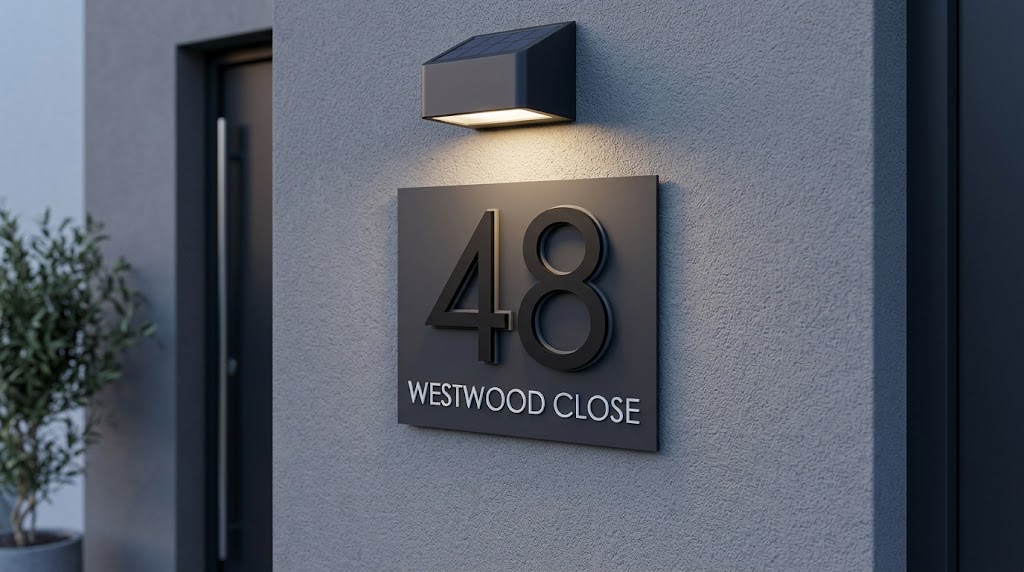
House Signs Direct takes emergency visibility incredibly seriously by utilising premium materials that simply do not degrade under extreme elemental pressure. By choosing heavy-duty rustic slate or contemporary 3D acrylic, homeowners create a permanent navigational beacon. This robust durability guarantees that first responders can always locate your family without hesitation.
How do missing door numbers affect ambulance response times?
Missing door numbers drastically increase ambulance response times by forcing paramedics to search neighbouring properties on foot. This unnecessary delay can add vital minutes to emergency interventions, significantly reducing the chances of successful outcomes during critical cardiac or respiratory events.
When emergency dispatchers cannot pinpoint a precise location, the ambulance crew is forced to knock on adjacent doors to verify the street layout. Every single wasted moment searching a darkened street exponentially increases the risk to the patient. Clear, illuminated numerals act as a vital lifeline connecting individuals in distress to immediate professional care.
First responders actively petition local governments to enforce strict numbering regulations precisely because navigational ambiguity costs lives. Installing a premium, highly reflective or solar-illuminated plaque is one of the easiest and most responsible home upgrades a property owner can make.
What is the best place to display my house sign for paramedics?
The best place to display your house sign for paramedics is directly adjacent to the front door or on the boundary wall or gate. It must face the road directly and be illuminated by street lighting or integrated solar options for optimal night-time visibility.
If your property features a long driveway, mounting the plaque strictly on the property line prevents paramedics from driving past the entrance. The figures should be positioned at eye level to ensure they are immediately caught by the headlights of approaching emergency vehicles. Consistency in placement allows drivers to scan the street logically without distraction.
Avoiding shadows cast by porches, mature trees, or deep architectural overhangs is equally crucial for maintaining a clear line of sight. By strategically placing a weather-resistant plaque in an unobstructed, well-lit zone, you drastically improve the safety and security of your entire household.
What are the Royal Mail rules for displaying house numbers?
Royal Mail requires all residential properties to display a clear, unambiguous house number to ensure efficient and accurate postal delivery. Clear numbering supports complex logistical sorting algorithms and prevents misdirected correspondence. Unfortunately, ignoring these fundamental visibility guidelines frequently triggers a cascading logistical failure.
This logistical failure manifests as continuous missed parcels, lost mail, and severely delayed essential documents. In fact, recent data from Loqate highlights that UK delivery failure rates stand at an astonishing 6%, largely driven by poor address accuracy and completely invisible home exterior details. Ensure you choose from our best selling house signs to actively prevent these frustrating and costly delays.
Furthermore, Citizens Advice reported that a staggering 15 million people were let down by parcel problems recently, a national crisis heavily worsened by hard-to-find houses. Eliminating navigational ambiguity guarantees your high-value packages and confidential letters reach your doorstep safely and securely.
Can postmen refuse to deliver if my house number is hidden?
Postmen and delivery drivers can legally refuse to deliver parcels if your house number is completely hidden or ambiguous. Postal workers are not obligated to guess property identities, and unnumbered homes will frequently see packages returned to the sorting depot as undeliverable.
Couriers operate under immense time pressure and simply cannot justify spending five minutes attempting to decipher a completely blank residential terrace. When a property cannot be verified beyond a reasonable doubt, internal safety and accuracy protocols require the driver to abandon the delivery attempt. This protects the courier from liability regarding misdelivered sensitive documents.
To ensure seamless logistics, homeowners must take proactive responsibility for their exterior address presentation. A crisp, prominent display built from highly durable materials completely eliminates driver confusion and ensures your online orders arrive exactly when expected.
Do missing house numbers increase delivery failure rates?
Missing house numbers are a primary catalyst for increased delivery failure rates across the UK. Couriers operating on strict time constraints cannot afford to spend minutes searching for hidden properties, inevitably logging the address as inaccessible and delaying your shipments.
The rise of independent gig-economy delivery drivers has further highlighted the absolute necessity of crystal-clear property identification. Unlike a regular postman who memorises a specific daily route, modern parcel couriers rely entirely on GPS and immediate visual confirmation to complete their drops. If your home lacks a visible identifier, the algorithm fails.
Investing in bespoke exterior craftsmanship immediately rectifies this modern logistical hurdle. By prominently displaying a premium acrylic or slate plaque, you actively facilitate a smoother, faster, and far more reliable delivery network right to your front door.
How can I ensure my house sign complies with UK regulations?
Ensuring your house sign complies with UK regulations involves selecting a highly contrasting, weather-resistant material positioned clearly at the property boundary. Adhering to municipal visibility guidelines protects homeowners from statutory fines. Yet, property renovators frequently overlook a critical mechanical detail during installation.
This critical detail is the use of robust, concealed mounting hardware that prevents the heavy plaque from shifting, warping, or dropping over time. Our premium designs arrive with precisely pre-drilled holes, standard wall plugs, and sophisticated hidden fixings to guarantee a secure, perfectly flush finish that stays compliant for decades.
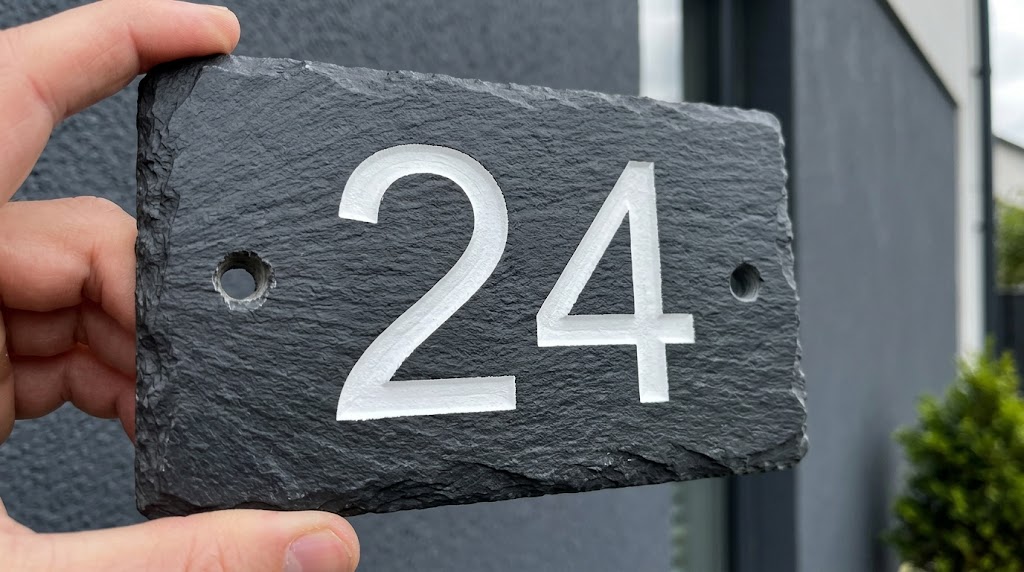
Upgrade your exterior architecture with our modern house number signs to perfectly balance stunning aesthetic kerb appeal with strict municipal statutory requirements.
Expert Insight: “Achieving the perfect balance between architectural elegance and statutory compliance requires precision deep-engraving that never degrades under harsh UV exposure.” – Patrick Green, Founder at House Signs Direct
What size should a legal house number sign be?
A legal house number sign should ideally feature digits that are a minimum of 75mm (3 inches) in height to ensure adequate visibility from the road. The size should scale up proportionately if your property is set further back from the public highway.
While there is no single national size mandate, local councils universally agree that microscopic lettering fundamentally fails the basic test of rapid legibility. Deep-engraved numerals ensure that the depth of the cut catches the light, creating a highly readable shadow effect that enhances visibility from a distance.
Always measure the intended mounting space before ordering to ensure the proportions look architecturally balanced. A substantial, well-proportioned plaque projects an immediate sense of permanence and meticulous care for your property.
Do I need planning permission to install a new door number?
You do not generally need planning permission to install a standard new door number on a residential property. However, if your home is a listed building or situated within a strict conservation area, you must consult your local planning authority before altering the exterior.
Conservation officers carefully regulate any aesthetic changes to historically significant architecture, including the style, material, and typography of external signage. In these protected zones, traditional materials like our hand-finished rustic slate are frequently approved due to their authentic, historically sympathetic appearance.
For the vast majority of standard modern homes across the nation, upgrading your exterior identification is considered permitted development. Trusting a reputable manufacturer like House Signs Direct ensures you receive a premium product that elevates your home’s prestige without administrative hassle.
Ready to upgrade your home’s kerb appeal with a bespoke finishing touch? Contact House Signs Direct today on 0116 2784844, or email House Signs Direct to discuss your perfect design.